One project will map and analyse migrational patterns of people who fled Hungary in 1956. While the focus of this project will be primarily on 1956 emigre communities, the data model will be set up in such a way that in can also accommodate other episodes of forced migration.
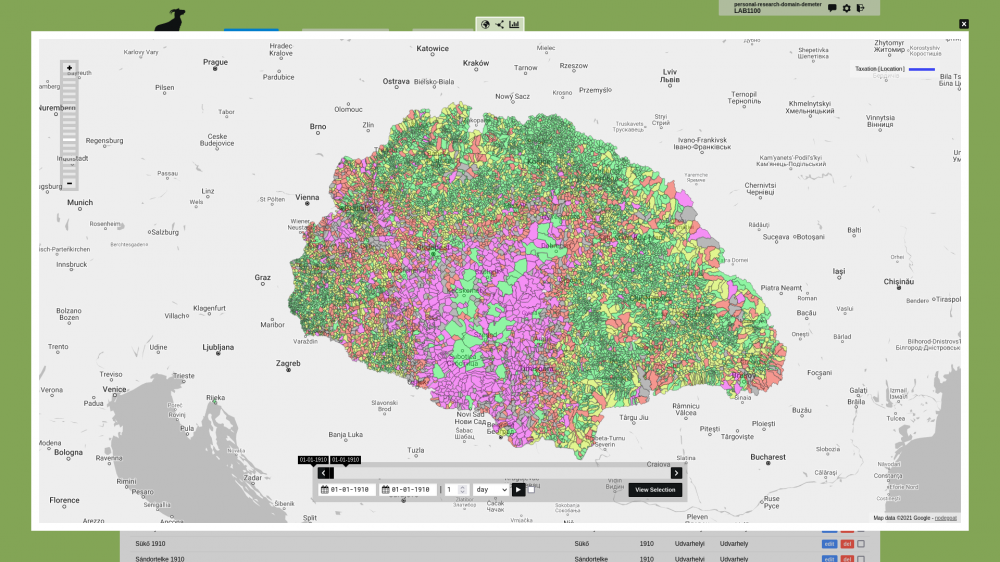
Another project is based on data coming from the GISta Hungarorum project. nodegoat will be used to visualise and analyse historical geographical data.
We have extended nodegoat in order to be able to communicate with large language models (LLMs). Conceptually this allows users of nodegoat to prompt their structured data. Technically this means nodegoat users are able to create vector embeddings for their objects and use these embeddings to perform retrieval-augmented generation (RAG) processes in nodegoat.
This development connects three of nodegoat’s main functionalities into a dynamic workflow: Linked Data Resources, the new vector store (nodegoat documentation: Object Descriptions, see ‘vector’), and Filtering. The steps to take are as follows:
Vector Embedding
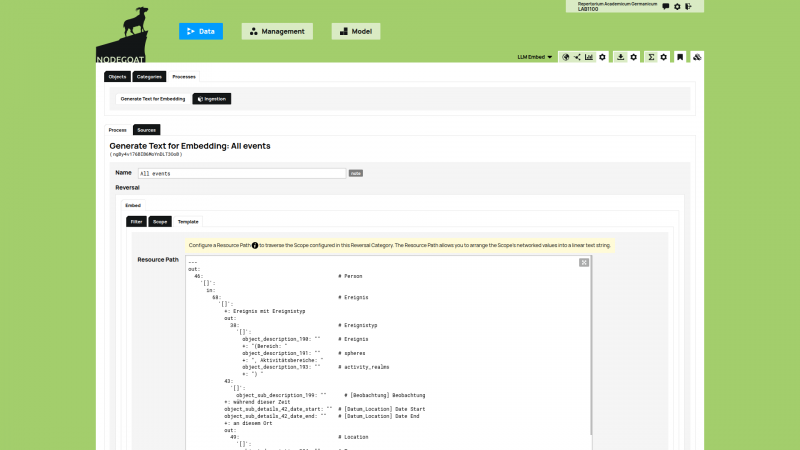
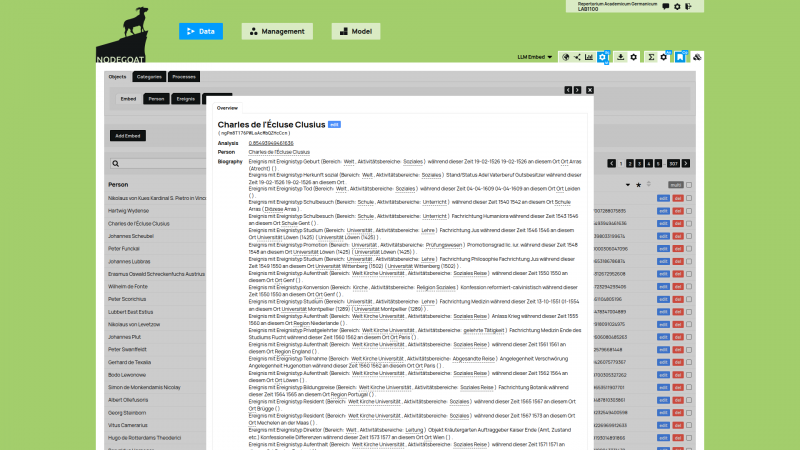
The first step is to use one or multiple Reversed Collection templates to determine the textual content for each Object. This step transforms any dataset stored as structured data into a textual representation that can be used as input value for the generation of a vector embedding. This allows the user to select only those elements that are relevant for the process.
A Reversed Collection using a template (left) to collect structured data into full text (right).
Next, the textual representation of each Object is sent to an LLM in order to create an embedding for each Object. The communication between nodegoat and an LLM is achieved by making use of Linked Data Resources and Ingestion Processes.[....]
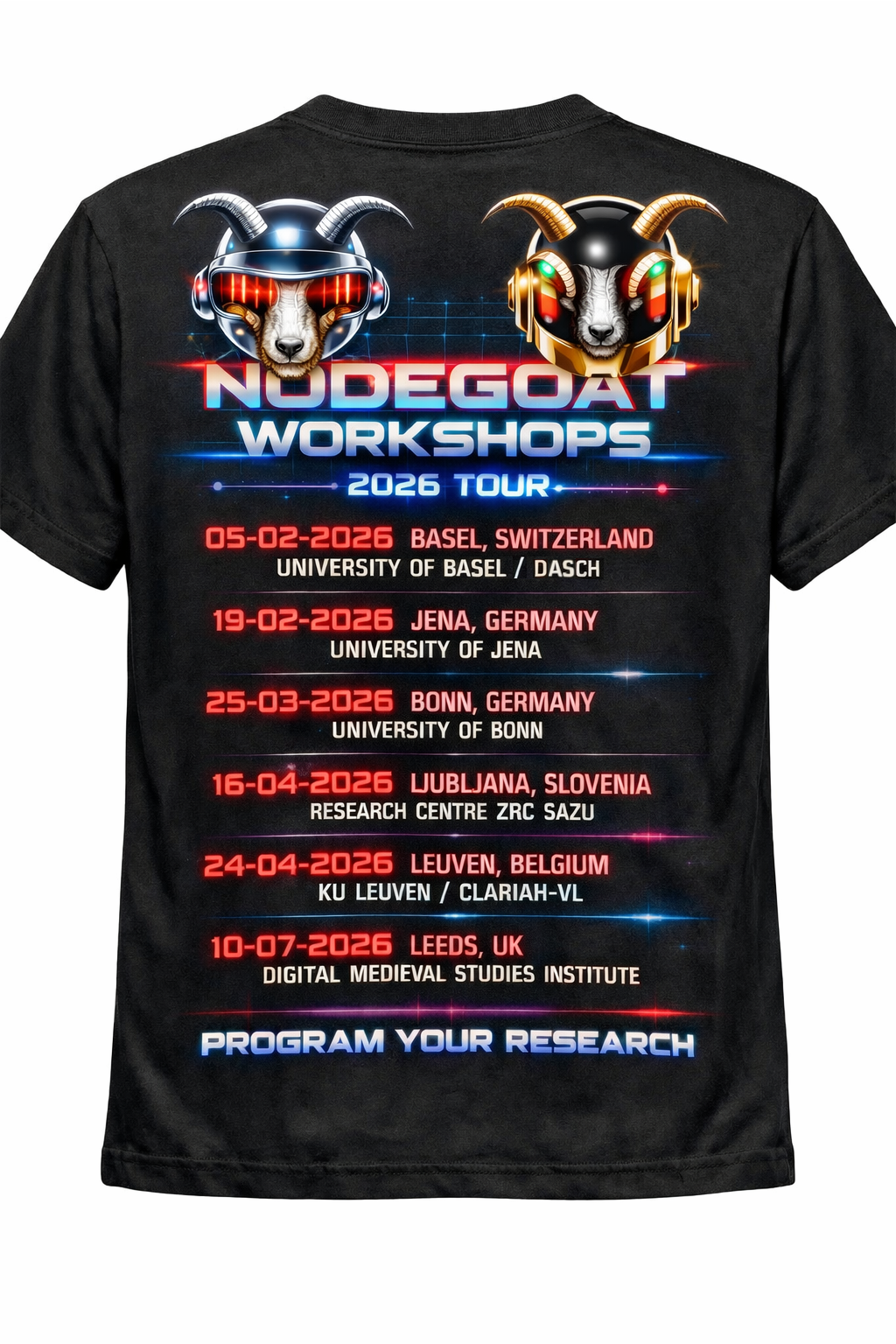
In the next couple of months we will be running these events at various locations throughout Europe. Find the latest information about this here: https://nodegoat.net/workshop
05-02-2026: nodegoat Workshop at the University of Basel organised by the Research and Infrastructure Support team and the Swiss National Data and Service Center for the Humanities.
19-02-2026: nodegoat Workshop at the University of Jena.
25-03-2026: Workshop: Einführung in nodegoat at the University of Bonn.
16-04-2026: nodegoat Workshop at the Research Centre of the Slovenian Academy of Sciences and Arts in Ljubljana.
24-04-2026: nodegoat Workshop at KU Leuven, organised by CLARIAH-VL.
10-07-2026: nodegoat Curious: Building a Custom Relational Database for Your Research at the Digital Medieval Studies Institute, IMC Leeds.
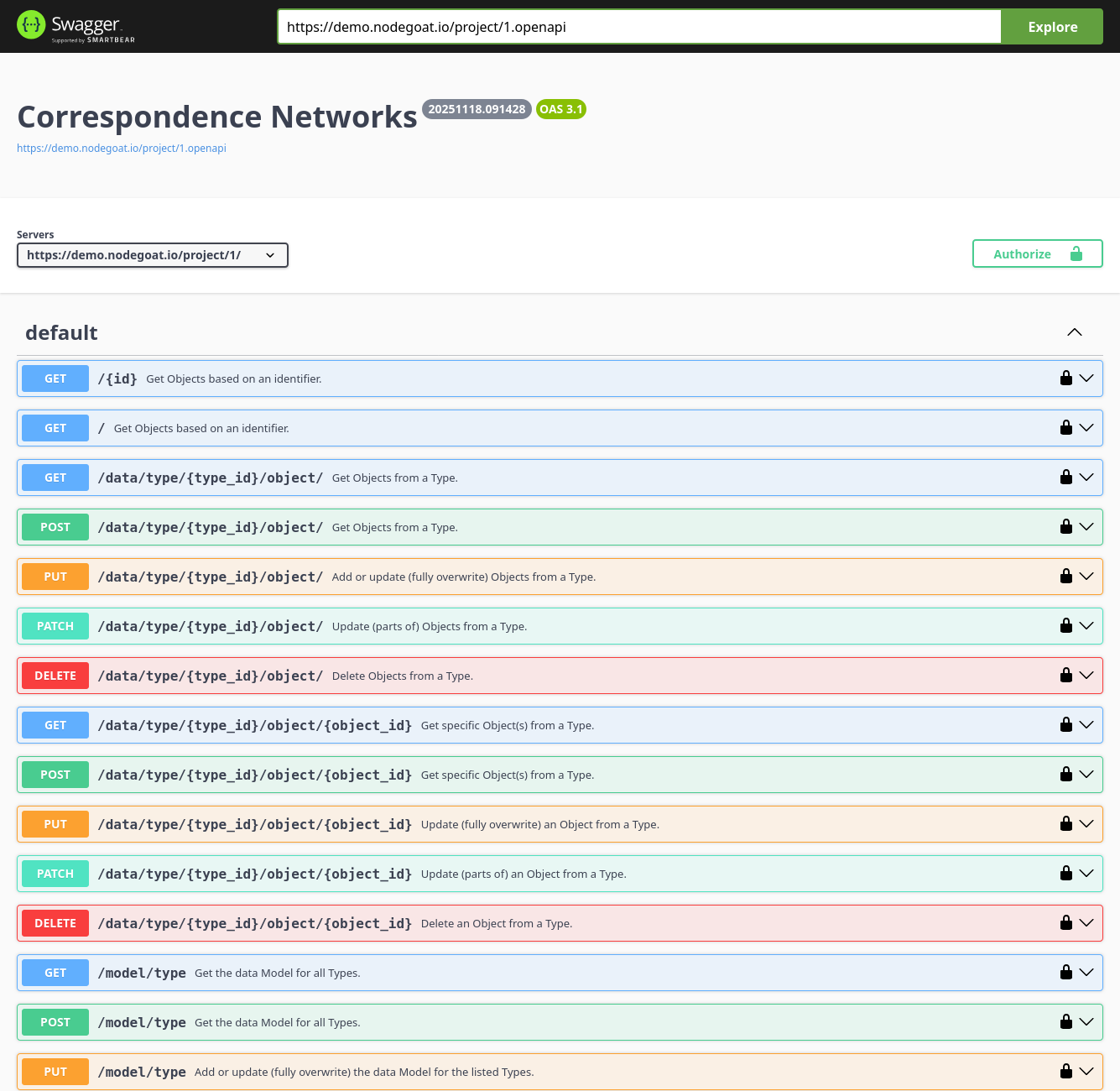
Every nodegoat API is now described by an OpenAPI Description (OAD). A .yaml file is automatically generated based on the current configuration of any project specific API. This machine-readable document describes all available endpoints for the selected project.