Launch of METROMOD Archive

CORE Admin

The ERC project 'METROMOD' that runs at the Ludwig Maximilian University of Munich has recently launched a public user interface for their nodegoat project: archive.metromod.net.

The published data deals with modern artistic and intellectual exile in six global arrival cities (Bombay, Buenos Aires, Istanbul, London, New York, Shanghai). You can learn more about the data publication in this blog post.

We developed a custom splash screen as an entry point to each section of the public user interface. Earlier, we built a data publication module for the METROMOD project to allow them to publish walks for the six metropoles: walks.metromod.net.

The design of both the Walks and the Archive has been created by Jamal Buscher of Bureau Johannes Erler.
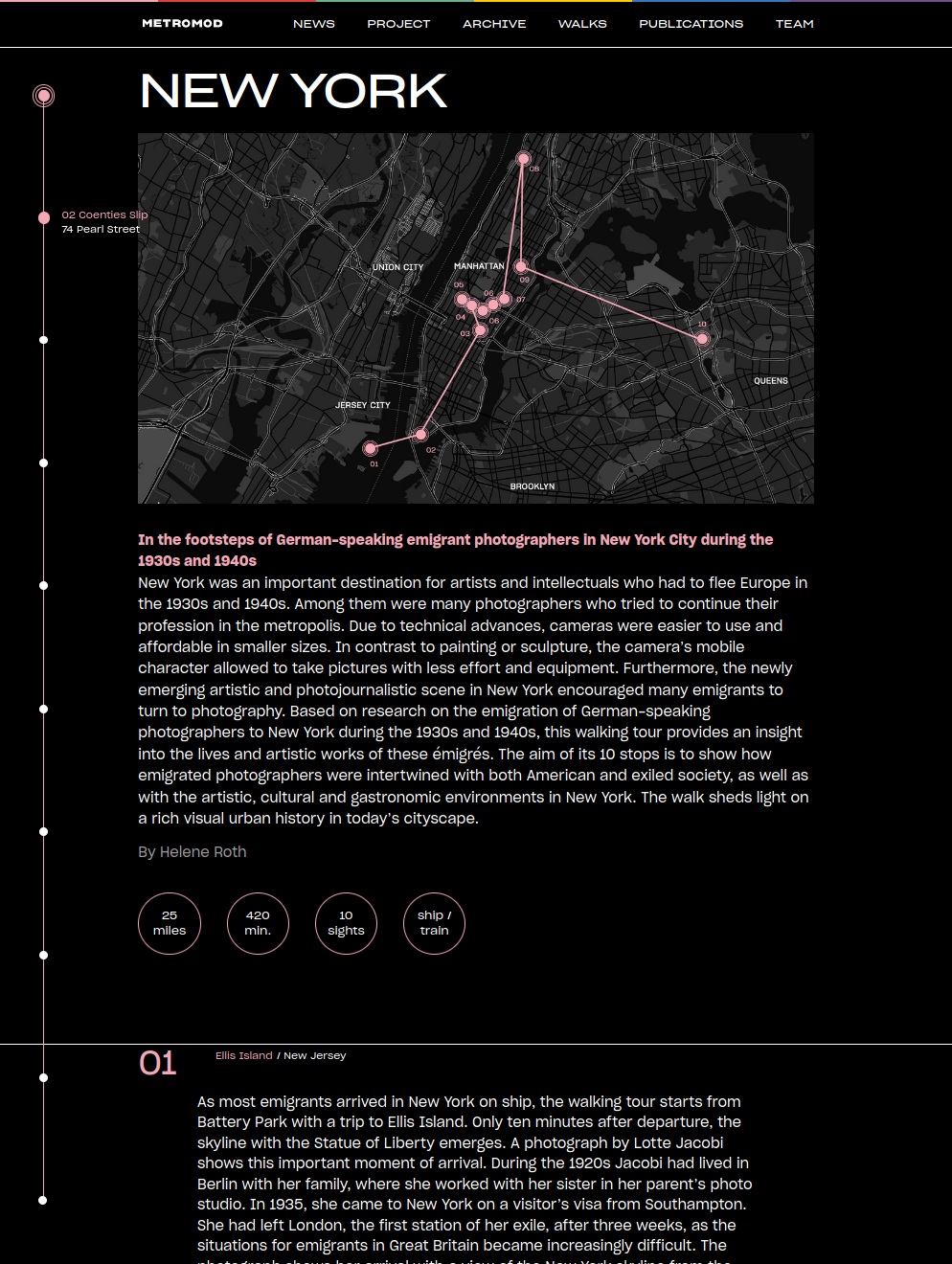
Explore these six walks via walks.metromod.net.

Latest Blog Posts

Data and Dialogue: Retrieval-Augmented Generation in nodegoat

CORE Admin

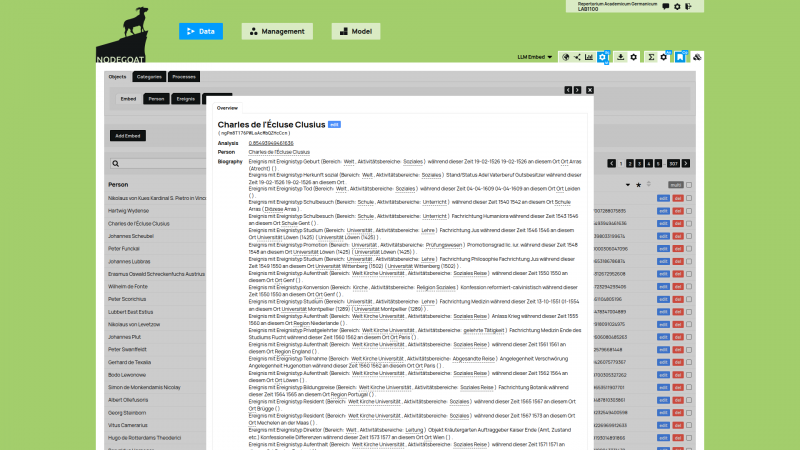
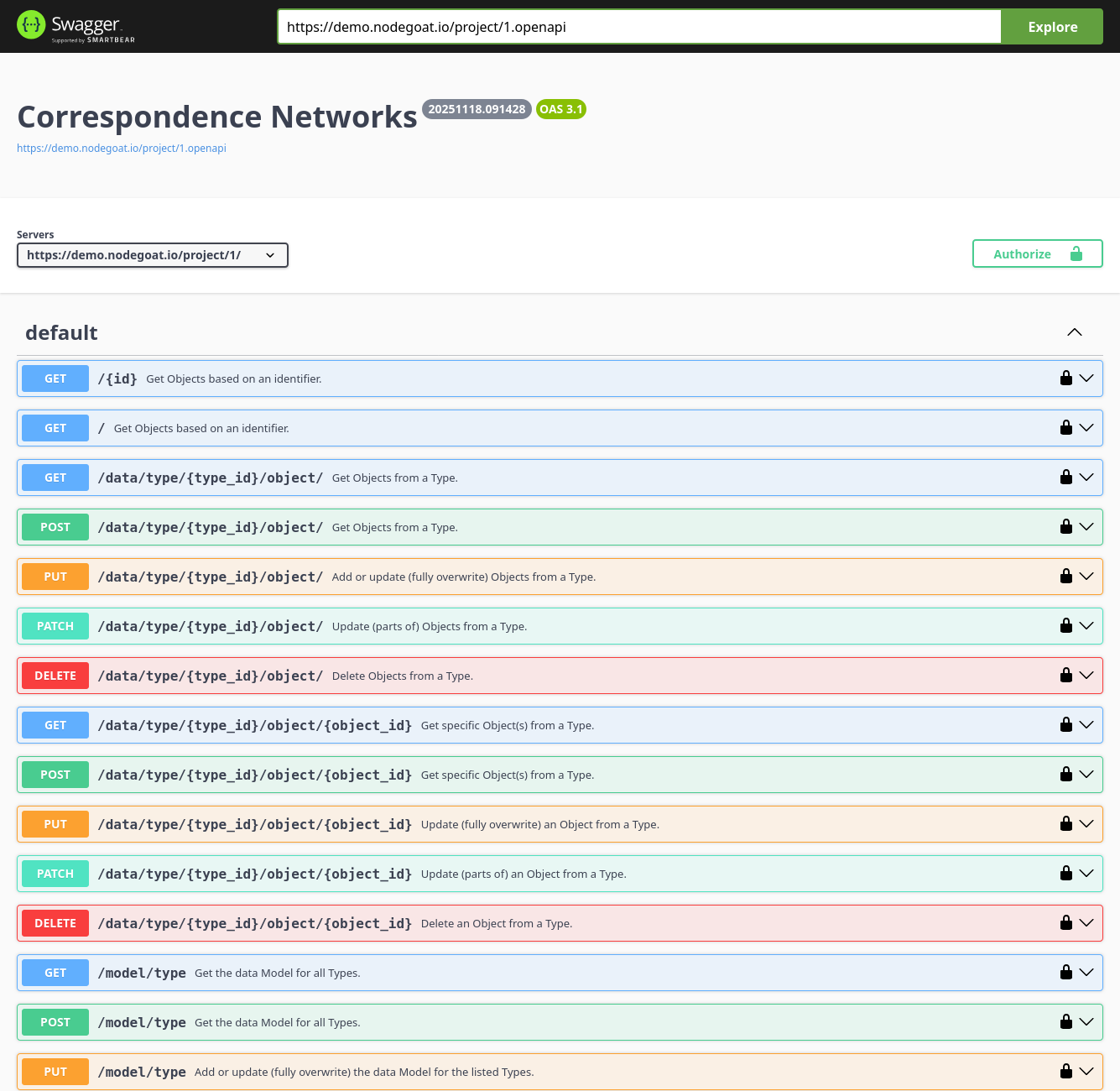
We have extended nodegoat in order to be able to communicate with large language models (LLMs). Conceptually this allows users of nodegoat to prompt their structured data. Technically this means nodegoat users are able to create vector embeddings for their objects and use these embeddings to perform retrieval-augmented generation (RAG) processes in nodegoat.

This development connects three of nodegoat’s main functionalities into a dynamic workflow:  Linked Data Resources, the new vector store (nodegoat documentation: Object Descriptions, see ‘vector’), and Filtering. The steps to take are as follows:

Vector Embedding

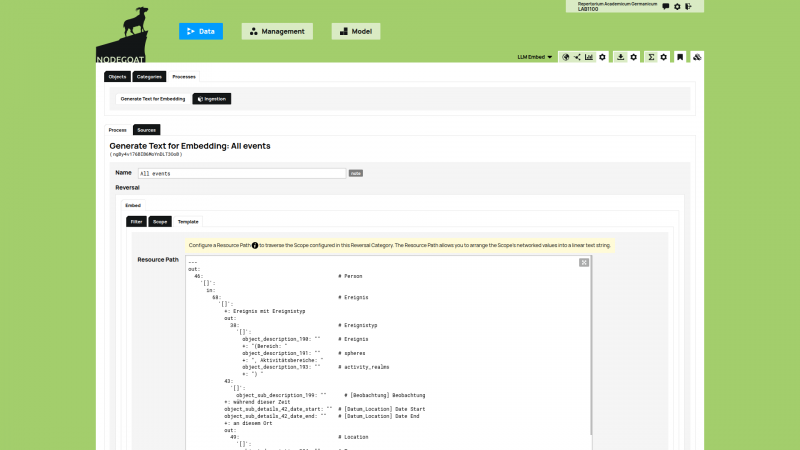
The first step is to use one or multiple Reversed Collection templates to determine the textual content for each Object. This step transforms any dataset stored as structured data into a textual representation that can be used as input value for the generation of a vector embedding. This allows the user to select only those elements that are relevant for the process.

A Reversed Collection using a template (left) to collect structured data into full text (right).

Next, the textual representation of each Object is sent to an LLM in order to create an embedding for each Object. The communication between nodegoat and an LLM is achieved by making use of Linked Data Resources and Ingestion Processes.[....]

Continue reading

Upcoming nodegoat workshops

CORE Admin

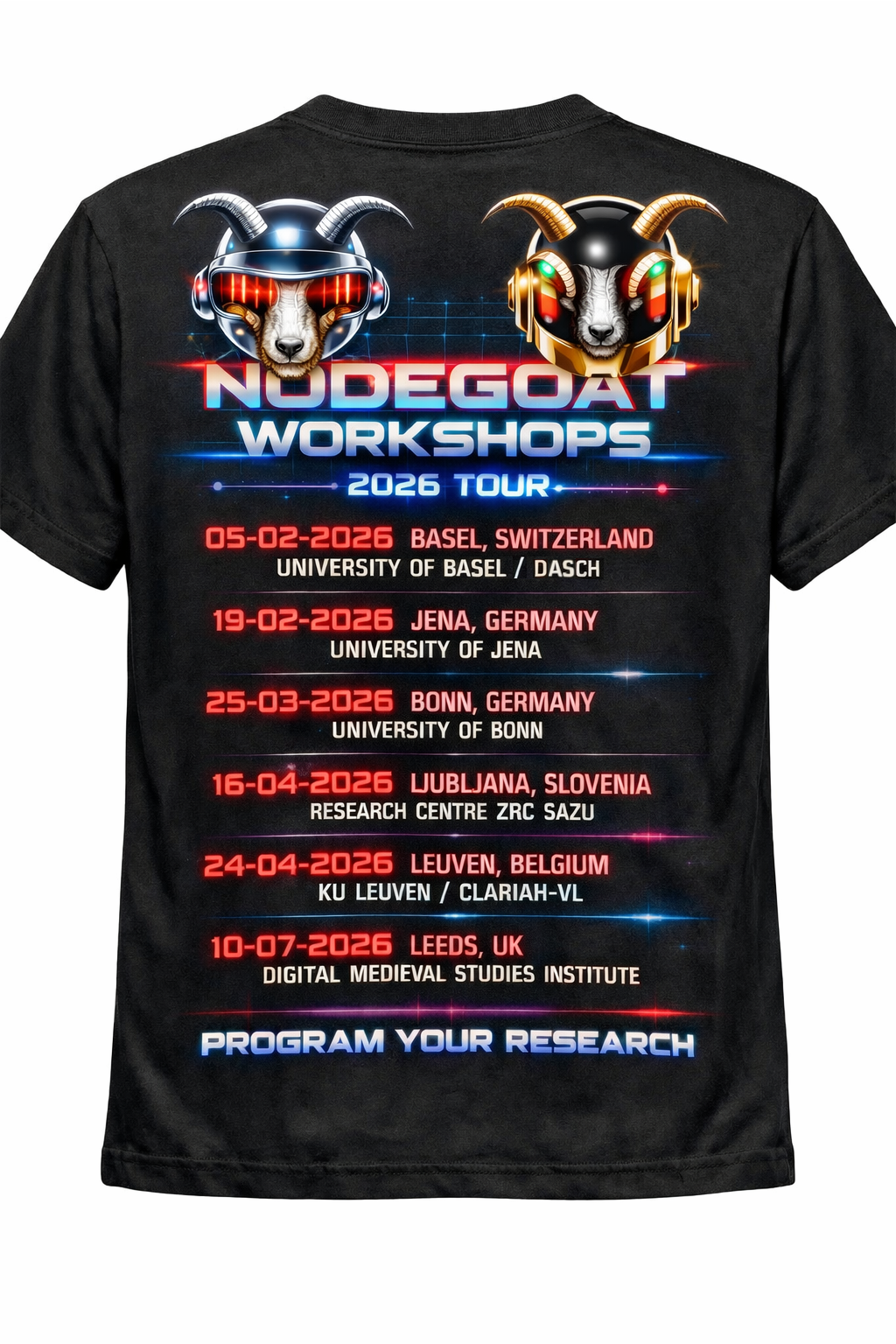
In the next couple of months we will be running these events at various locations throughout Europe. Find the latest information about this here: https://nodegoat.net/workshop

  • 05-02-2026: nodegoat Workshop at the University of Basel organised by the Research and Infrastructure Support team and the Swiss National Data and Service Center for the Humanities.
  • 19-02-2026: nodegoat Workshop at the University of Jena.
  • 25-03-2026: Workshop: Einführung in nodegoat at the University of Bonn.
  • 16-04-2026: nodegoat Workshop at the Research Centre of the Slovenian Academy of Sciences and Arts in Ljubljana.
  • 24-04-2026: nodegoat Workshop at KU Leuven, organised by CLARIAH-VL.
  • 10-07-2026: nodegoat Curious: Building a Custom Relational Database for Your Research at the Digital Medieval Studies Institute, IMC Leeds.
Continue reading